

Overview of 5-amino-1MQ
5-amino-1MQ (5-amino-1-methylquinolinium), a methylquinolinium analogue, is a short peptide inhibitor of cytosolic nicotinamide N-methyltransferase (NNMT). The NNMT enzyme has been linked to obesity and type 2 diabetes and is known to play a role in cellular energy homeostasis. NNMT inhibition produces significant weight loss, a reduction in fat mass and adipocyte size, as well as lower plasma cholesterol and glucose levels. 5-amino-1MQ and other methylquinolinium derivatives are being investigated as potential treatments for obesity and diabetes. NNMT inhibition also appears capable of activating stem cells and improving the regenerative capacity of skeletal muscle.
Structure of 5-amino-1MQ
Molecular formula: C10H11N2
Molecular weight: 159.21 g/mol
PubChem CID: 950107
CAS number: 42464-96-0
Synonyms: 5-amino-1-methylquinolinium

Source: PubChem
Research on 5-amino-1MQ
Obesity
Nicotinamide N-methyltransferase (NNMT) is a cytosolic enzyme found in many cells throughout the body, but it is most abundant in the liver and adipose cells. Research in mice shows that elevated NNMT levels are associated with reduced levels of the GLUT4 glucose transporter. GLUT4, which is found primarily in striated muscle (skeletal and cardiac) and adipose cells, is closely linked to blood glucose levels and the development of diabetes. In rodent studies, mice that produce high levels of GLUT4 are insulin-sensitive and relatively resistant to developing type 2 diabetes, whereas mice with low GLUT4 levels exhibit marked insulin resistance.
In fact, GLUT4 has been linked to basal metabolic rate and to the concepts of fast and slow metabolism. People with naturally high GLUT4 levels have a faster metabolism than those with low levels and therefore burn more calories. Production of this transporter is also stimulated by exercise, which helps explain why exercise can help address weight loss, elevated blood glucose levels, and insulin resistance. GLUT4 and NNMT are closely related to one another and to basal metabolism in mammals [1]. According to Dr. Barbara Kahn of Harvard Medical School, the connection between GLUT4 and NNMT prompted research into the latter enzyme as a potential therapeutic target for treating diabetes and obesity. High NNMT levels are commonly found in the adipose cells of insulin-resistant animals. Manipulating this gene helps counter insulin resistance and, consequently, diabetes. It also has a profound effect on weight and obesity.
Human metabolism, and indeed the metabolism of all animals, is highly efficient, making the most of a limited number of calories. Unfortunately, this same efficiency may be the mechanism underlying our predisposition to obesity in the context of excessive caloric intake. Reducing the efficiency of human metabolism, causing the body to waste calories, has long been a central medical objective in the fight against the growing obesity epidemic. NNMT and its interactions with GLUT4 may be the link scientists have been seeking [2], [3].
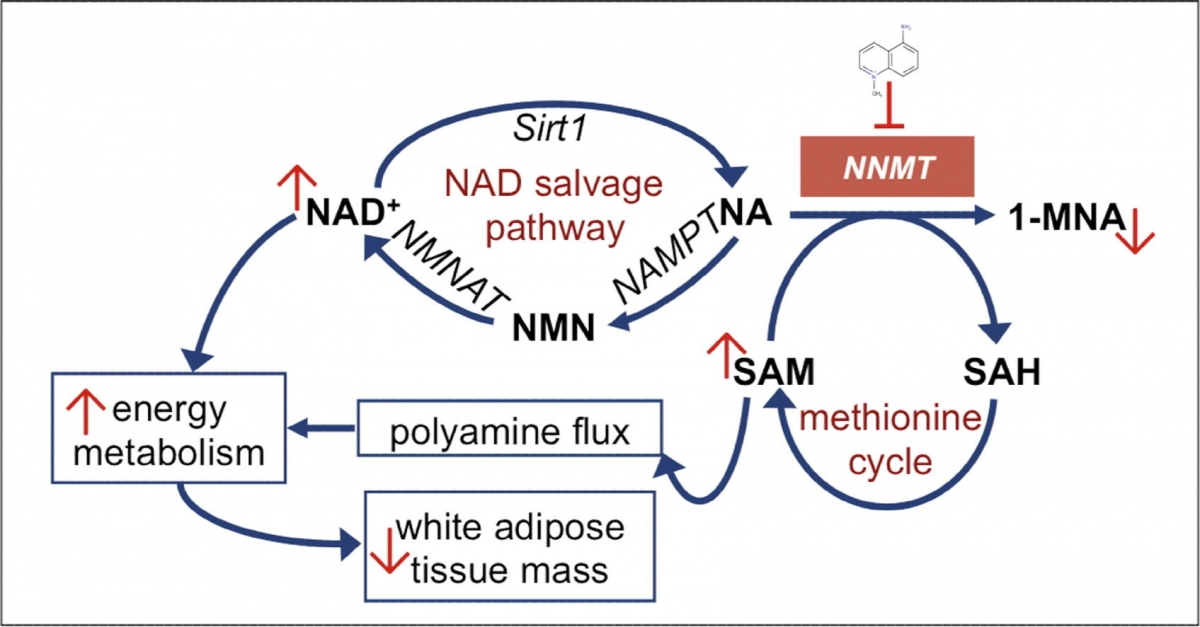
At its most basic level, NNMT slows the rate at which the body uses calories, leaving them available for storage as fat or glycogen. Lowering NNMT levels reduces the conversion of nicotinic acid (NA) into 1-methylnicotinamide (1-MNA). This process has two effects on metabolism, as detailed below.
Source: Science Direct
The net result of administering an NNMT blocker such as 5-amino-1MQ is increased energy burning and decreased energy storage. When combined with the fact that lowering NNMT levels also increases expression of the GLUT4 transporter, the result is a formula for improving glucose clearance from the blood and, consequently, its final disposal after being burned. The outcomes include a reduced need for insulin, lower insulin resistance, decreased fat production, and increased energy metabolism. Studies in mice given 5-amino-1MQ for as little as 10 days show a 7% reduction in basal metabolic rate and a 30% reduction in fat mass. In addition, blood cholesterol levels in treated mice are equal to those of non-obese mice. Notably, these changes occur without any alteration in food intake [5]. Mice administered 5-amino-1MQ show a 7% reduction in body mass in just 10 days, with no change in food intake compared with controls.

Source: Science Direct
More recent evidence suggests that the benefits of 5-amino-1MQ may extend beyond its ability to downregulate NNMT and thereby increase inefficient metabolism and GLUT4 expression. Research in mice suggests that, by enhancing GLUT4 expression, 5-amino-1MQ may alter adipose-cell function, inducing these cells to produce an alternative class of lipids with antidiabetic and anti-inflammatory effects. This class of lipids, known as PAHSAs (palmitic acid esters of hydroxy stearic acids), can independently reduce insulin resistance and decrease inflammation, thereby improving the risk profile for events such as heart attack and stroke [6]. Although this aspect of 5-amino-1MQ is relatively new, it suggests a broader benefit profile for an already remarkable molecule.
5-Amino-1MQ and Muscle Function
The impact of 5-amino-1MQ on skeletal muscle is multifaceted. As in adipose tissue, the presence of 5-amino-1MQ in muscle promotes production of the GLUT4 receptor and increases metabolic inefficiency, leading to greater energy expenditure. However, recent research in mice suggests that NNMT inhibition, including with 5-amino-1MQ, may enhance muscle repair by stimulating stem cells.
Studies in 24-month-old mice—an advanced age for mice—show that animals treated with an NNMT inhibitor experience substantial activation of stem cells in muscle tissue following injury compared with controls. These mice have myofibers with twice the cross-sectional area and greater contractile strength. In fact, mice treated with NNMT inhibitors have 70% greater contractile strength in repaired muscle than control mice [7]. The benefits of increasing muscle stem-cell production extend far beyond simply accelerating repair after injury. Stem-cell stimulation could help older adults maintain their independence for much longer. By improving mobility and reducing the risk of falls, NNMT inhibitors could substantially enhance older adults’ quality of life and independence.
There is also evidence that increased NNMT expression is a common feature of muscle-wasting disorders such as Duchenne muscular dystrophy, and that reducing NNMT levels may help relieve symptoms of some of these conditions [8]. Again, this is related to NNMT’s ability to inhibit stem-cell growth and division. By lowering NNMT levels, compounds such as 5-amino-1MQ may be beneficial in various muscle-wasting conditions.
The precise effects of NNMT inhibition on muscle function are not fully understood, but another component appears to be related to NAD+ levels. It is worth recalling that NNMT inhibition produces an increase in NAD+ levels. By replenishing NAD+ through NNMT inhibition, compounds such as 5-amino-1MQ have been shown to improve muscle function, cardiac pathology, and DMD in animal models. Improved mitochondrial function, together with reduced inflammation and fibrosis—all associated with increased NAD+ levels—appear to be the primary factors underlying these benefits [9].
A Possible Role for 5-Amino-1MQ in Cognition
NAD+ is a fundamental compound in brain energy homeostasis. NAD+ deficiency has been linked to various cognitive conditions and is known to affect communication at neuronal synapses and at the neuromuscular junction, where nerves connect with muscle tissue. Research in mice suggests that reduced NAD+ levels can decrease synaptic transmission, impair muscle function, and affect overall cognitive function [10]. Although 5-amino-1MQ has not been specifically tested in this context, there are good reasons to believe that the compound will have the same effect on NAD+ levels in the brain as it does elsewhere in the body. This means it could potentially be used not only as a treatment for cognitive dysfunction but also as a nootropic to enhance cognitive function in the general population. Whether research confirms this remains to be seen, but there is considerable interest in the potential cognitive benefits of 5-amino-1MQ.
NNMT and Cancer
A substantial body of research suggests that NNMT expression is increased in all types of gastric cancer, as well as in pancreatic cancer, renal cell carcinoma, and bladder cancer. Mice lacking the NNMT gene show resistance to developing these cancers, suggesting a causal role for NNMT. Although research is still ongoing, it has been speculated that NNMT inhibition could provide a way to treat and prevent certain types of cancer or, at minimum, reduce their aggressiveness [8]. It remains to be seen whether 5-amino-1MQ, by reducing NNMT function, will have any effect on the various cancers mentioned.
Summary of 5-amino-1MQ
5-amino-1MQ is a small, membrane-permeable analogue of naturally occurring methylquinolinium. In animal models, it has been shown to inhibit expression of the enzyme nicotinamide N-methyltransferase. NNMT is an important component of cellular energy metabolism and has been closely linked to weight control and insulin resistance.
Article Author
The preceding literature was researched, edited, and organized by Dr. E. Logan, M.D. Dr. E. Logan holds a medical degree from the Case Western Reserve University School of Medicine and a bachelor’s degree in molecular biology.
Scientific Journal Author
Barbara B. Kahn is being referenced as one of the leading scientists involved in the research and development of 5-Amino-1MQ. In no way is this doctor/scientist endorsing or advocating the purchase, sale, or use of this product for any reason. There is no affiliation or relationship, implied or otherwise, between Peptide Sciences and this doctor. The purpose of citing the doctor is to acknowledge, recognize, and credit the exhaustive research and development efforts conducted by the scientists studying this peptide. Barbara B. Kahn is listed in [2] and [6] under the referenced citations.
Barbara B. Kahn is Chief of the Division of Endocrinology, Diabetes, and Metabolism at Beth Israel Deaconess Medical Center (BIDMC) and the George Richards Minot Professor of Medicine at Harvard Medical School. She is an internationally renowned scientist in the fields of obesity and type 2 diabetes, and her laboratory investigates the molecular mechanisms underlying these conditions, including the regulation of insulin action, food intake, and energy balance. Kahn earned her bachelor’s degree and medical degree from Stanford University and a master’s degree from the University of California, Berkeley. After completing her internal medicine training at UC Davis Medical Center, she began her career in molecular research at the National Institutes of Health. Kahn has received numerous awards, including the American Diabetes Association Outstanding Scientific Achievement Award; the H. C. Jacobaeus Prize from the Novo Nordisk Foundation and Karolinska Institute; the Charles H. Best Lectureship and Award from the University of Toronto; and the Endocrine Society’s Gerald D. Aurbach Award Lecture. Kahn was elected to the National Academies’ Institute of Medicine and is a Fellow of the American Association for the Advancement of Science.
Barbara B. Kahn is referenced as one of the leading scientists involved in the research and development of 5-Amino-1MQ. This doctor/scientist does not endorse or advocate the purchase, sale, or use of this product for any reason. There is no affiliation or relationship, implied or otherwise, between Peptide Sciences and this doctor. The purpose of citing her is to acknowledge, recognize, and credit the extensive research and development efforts carried out by the scientists studying this peptide. Barbara B. Kahn is listed in references [2] and [6] under the cited references.
Referenced Citations
- Y.-B. Kim et al., “Muscle-Specific Deletion of the Glut4 Glucose Transporter Alters Multiple Regulatory Steps in Glycogen Metabolism,” Mol. Cell. Biol., vol. 25, no. 21, pp. 9713–9723, Nov. 2005, doi: 10.1128/MCB.25.21.9713-9723.2005.
- E. Carvalho, K. Kotani, O. D. Peroni, and B. B. Kahn, “Adipose-specific overexpression of GLUT4 reverses insulin resistance and diabetes in mice lacking GLUT4 selectively in muscle,” Am. J. Physiol. Endocrinol. Metab., vol. 289, no. 4, pp. E551-561, Oct. 2005, doi: 10.1152/ajpendo.00116.2005.
- “Weight loss without effort: NNMT inhibitors,” Recherche animale. https://www.recherche-animale.org/en/weight-loss-without-effort-nnmt-inhibitors (accessed Mar. 30, 2020).
- N. Minois, D. Carmona-Gutierrez, and F. Madeo, “Polyamines in aging and disease,” Aging, vol. 3, no. 8, pp. 716–732, Aug. 2011.
- H. Neelakantan et al., “Selective and membrane-permeable small molecule inhibitors of nicotinamide N-methyltransferase reverse high fat diet-induced obesity in mice,” Biochem. Pharmacol., vol. 147, pp. 141–152, Jan. 2018, doi: 10.1016/j.bcp.2017.11.007.
- P. M. Moraes-Vieira, A. Saghatelian, and B. B. Kahn, “GLUT4 Expression in Adipocytes Regulates De Novo Lipogenesis and Levels of a Novel Class of Lipids With Antidiabetic and Anti-inflammatory Effects,” Diabetes, vol. 65, no. 7, pp. 1808–1815, Jul. 2016, doi: 10.2337/db16-0221.
- H. Neelakantan et al., “Small molecule nicotinamide N-methyltransferase inhibitor activates senescent muscle stem cells and improves regenerative capacity of aged skeletal muscle,” Biochem. Pharmacol., vol. 163, Feb. 2019, doi: 10.1016/j.bcp.2019.02.008.
- P. Pissios, “Nicotinamide N-methyltransferase: more than a vitamin B3 clearance enzyme,” Trends Endocrinol. Metab. TEM, vol. 28, no. 5, pp. 340–353, May 2017, doi: 10.1016/j.tem.2017.02.004.
- D. Ryu et al., “NAD+ repletion improves muscle function in muscular dystrophy and counters global PARylation,” Sci. Transl. Med., vol. 8, no. 361, p. 361ra139, Oct. 2016, doi: 10.1126/scitranslmed.aaf5504.
- S. Lundt, N. Zhang, X. Wang, L. Polo-Parada, and S. Ding, “The effect of NAMPT deletion in projection neurons on the function and structure of neuromuscular junction (NMJ) in mice,” Sci. Rep., vol. 10, Jan. 2020, doi: 10.1038/s41598-019-57085-4.
All articles and product information provided on this website are intended solely for informational and educational purposes.
The products offered on this website are provided solely for in vitro studies. In vitro studies (Latin: in glass) are conducted outside the body. These products are not medicines or drugs and have not been approved by the FDA to prevent, treat, or cure any condition, ailment, or disease. Their introduction into the body, whether in humans or animals, is strictly prohibited by law.
Overview of 5-amino-1MQ
5-amino-1MQ (5-amino-1-methylquinolinium), a methylquinolinium analogue, is a short peptide inhibitor of cytosolic nicotinamide N-methyltransferase (NNMT). The NNMT enzyme has been linked to obesity and type 2 diabetes and is known to play a role in cellular energy homeostasis. NNMT inhibition produces significant weight loss, a reduction in fat mass and adipocyte size, as well as lower plasma cholesterol and glucose levels. 5-amino-1MQ and other methylquinolinium derivatives are being investigated as potential treatments for obesity and diabetes. NNMT inhibition also appears capable of activating stem cells and improving the regenerative capacity of skeletal muscle.
Structure of 5-amino-1MQ
Molecular formula: C10H11N2
Molecular weight: 159.21 g/mol
PubChem CID: 950107
CAS number: 42464-96-0
Synonyms: 5-amino-1-methylquinolinium
Source: PubChem
Research on 5-amino-1MQ
Obesity
Nicotinamide N-methyltransferase (NNMT) is a cytosolic enzyme found in many cells throughout the body, but it is most abundant in the liver and adipose cells. Research in mice shows that elevated NNMT levels are associated with reduced levels of the GLUT4 glucose transporter. GLUT4, which is found primarily in striated muscle (skeletal and cardiac) and adipose cells, is closely linked to blood glucose levels and the development of diabetes. In rodent studies, mice that produce high levels of GLUT4 are insulin-sensitive and relatively resistant to developing type 2 diabetes, whereas mice with low GLUT4 levels exhibit marked insulin resistance.
In fact, GLUT4 has been linked to basal metabolic rate and to the concepts of fast and slow metabolism. People with naturally high GLUT4 levels have a faster metabolism than those with low levels and therefore burn more calories. Production of this transporter is also stimulated by exercise, which helps explain why exercise can help address weight loss, elevated blood glucose levels, and insulin resistance. GLUT4 and NNMT are closely related to one another and to basal metabolism in mammals [1]. According to Dr. Barbara Kahn of Harvard Medical School, the connection between GLUT4 and NNMT prompted research into the latter enzyme as a potential therapeutic target for treating diabetes and obesity. High NNMT levels are commonly found in the adipose cells of insulin-resistant animals. Manipulating this gene helps counter insulin resistance and, consequently, diabetes. It also has a profound effect on weight and obesity.
Human metabolism, and indeed the metabolism of all animals, is highly efficient, making the most of a limited number of calories. Unfortunately, this same efficiency may be the mechanism underlying our predisposition to obesity in the context of excessive caloric intake. Reducing the efficiency of human metabolism, causing the body to waste calories, has long been a central medical objective in the fight against the growing obesity epidemic. NNMT and its interactions with GLUT4 may be the link scientists have been seeking [2], [3].
At its most basic level, NNMT slows the rate at which the body uses calories, leaving them available for storage as fat or glycogen. Lowering NNMT levels reduces the conversion of nicotinic acid (NA) into 1-methylnicotinamide (1-MNA). This process has two effects on metabolism, as detailed below.
Source: Science Direct
The net result of administering an NNMT blocker such as 5-amino-1MQ is increased energy burning and decreased energy storage. When combined with the fact that lowering NNMT levels also increases expression of the GLUT4 transporter, the result is a formula for improving glucose clearance from the blood and, consequently, its final disposal after being burned. The outcomes include a reduced need for insulin, lower insulin resistance, decreased fat production, and increased energy metabolism. Studies in mice given 5-amino-1MQ for as little as 10 days show a 7% reduction in basal metabolic rate and a 30% reduction in fat mass. In addition, blood cholesterol levels in treated mice are equal to those of non-obese mice. Notably, these changes occur without any alteration in food intake [5]. Mice administered 5-amino-1MQ show a 7% reduction in body mass in just 10 days, with no change in food intake compared with controls.
Source: Science Direct
More recent evidence suggests that the benefits of 5-amino-1MQ may extend beyond its ability to downregulate NNMT and thereby increase inefficient metabolism and GLUT4 expression. Research in mice suggests that, by enhancing GLUT4 expression, 5-amino-1MQ may alter adipose-cell function, inducing these cells to produce an alternative class of lipids with antidiabetic and anti-inflammatory effects. This class of lipids, known as PAHSAs (palmitic acid esters of hydroxy stearic acids), can independently reduce insulin resistance and decrease inflammation, thereby improving the risk profile for events such as heart attack and stroke [6]. Although this aspect of 5-amino-1MQ is relatively new, it suggests a broader benefit profile for an already remarkable molecule.
5-Amino-1MQ and Muscle Function
The impact of 5-amino-1MQ on skeletal muscle is multifaceted. As in adipose tissue, the presence of 5-amino-1MQ in muscle promotes production of the GLUT4 receptor and increases metabolic inefficiency, leading to greater energy expenditure. However, recent research in mice suggests that NNMT inhibition, including with 5-amino-1MQ, may enhance muscle repair by stimulating stem cells.
Studies in 24-month-old mice—an advanced age for mice—show that animals treated with an NNMT inhibitor experience substantial activation of stem cells in muscle tissue following injury compared with controls. These mice have myofibers with twice the cross-sectional area and greater contractile strength. In fact, mice treated with NNMT inhibitors have 70% greater contractile strength in repaired muscle than control mice [7]. The benefits of increasing muscle stem-cell production extend far beyond simply accelerating repair after injury. Stem-cell stimulation could help older adults maintain their independence for much longer. By improving mobility and reducing the risk of falls, NNMT inhibitors could substantially enhance older adults’ quality of life and independence.
There is also evidence that increased NNMT expression is a common feature of muscle-wasting disorders such as Duchenne muscular dystrophy, and that reducing NNMT levels may help relieve symptoms of some of these conditions [8]. Again, this is related to NNMT’s ability to inhibit stem-cell growth and division. By lowering NNMT levels, compounds such as 5-amino-1MQ may be beneficial in various muscle-wasting conditions.
The precise effects of NNMT inhibition on muscle function are not fully understood, but another component appears to be related to NAD+ levels. It is worth recalling that NNMT inhibition produces an increase in NAD+ levels. By replenishing NAD+ through NNMT inhibition, compounds such as 5-amino-1MQ have been shown to improve muscle function, cardiac pathology, and DMD in animal models. Improved mitochondrial function, together with reduced inflammation and fibrosis—all associated with increased NAD+ levels—appear to be the primary factors underlying these benefits [9].
A Possible Role for 5-Amino-1MQ in Cognition
NAD+ is a fundamental compound in brain energy homeostasis. NAD+ deficiency has been linked to various cognitive conditions and is known to affect communication at neuronal synapses and at the neuromuscular junction, where nerves connect with muscle tissue. Research in mice suggests that reduced NAD+ levels can decrease synaptic transmission, impair muscle function, and affect overall cognitive function [10]. Although 5-amino-1MQ has not been specifically tested in this context, there are good reasons to believe that the compound will have the same effect on NAD+ levels in the brain as it does elsewhere in the body. This means it could potentially be used not only as a treatment for cognitive dysfunction but also as a nootropic to enhance cognitive function in the general population. Whether research confirms this remains to be seen, but there is considerable interest in the potential cognitive benefits of 5-amino-1MQ.
NNMT and Cancer
A substantial body of research suggests that NNMT expression is increased in all types of gastric cancer, as well as in pancreatic cancer, renal cell carcinoma, and bladder cancer. Mice lacking the NNMT gene show resistance to developing these cancers, suggesting a causal role for NNMT. Although research is still ongoing, it has been speculated that NNMT inhibition could provide a way to treat and prevent certain types of cancer or, at minimum, reduce their aggressiveness [8]. It remains to be seen whether 5-amino-1MQ, by reducing NNMT function, will have any effect on the various cancers mentioned.
Summary of 5-amino-1MQ
5-amino-1MQ is a small, membrane-permeable analogue of naturally occurring methylquinolinium. In animal models, it has been shown to inhibit expression of the enzyme nicotinamide N-methyltransferase. NNMT is an important component of cellular energy metabolism and has been closely linked to weight control and insulin resistance.
Article Author
The preceding literature was researched, edited, and organized by Dr. E. Logan, M.D. Dr. E. Logan holds a medical degree from the Case Western Reserve University School of Medicine and a bachelor’s degree in molecular biology.
Scientific Journal Author
Barbara B. Kahn is being referenced as one of the leading scientists involved in the research and development of 5-Amino-1MQ. In no way is this doctor/scientist endorsing or advocating the purchase, sale, or use of this product for any reason. There is no affiliation or relationship, implied or otherwise, between Peptide Sciences and this doctor. The purpose of citing the doctor is to acknowledge, recognize, and credit the exhaustive research and development efforts conducted by the scientists studying this peptide. Barbara B. Kahn is listed in [2] and [6] under the referenced citations.
Barbara B. Kahn is Chief of the Division of Endocrinology, Diabetes, and Metabolism at Beth Israel Deaconess Medical Center (BIDMC) and the George Richards Minot Professor of Medicine at Harvard Medical School. She is an internationally renowned scientist in the fields of obesity and type 2 diabetes, and her laboratory investigates the molecular mechanisms underlying these conditions, including the regulation of insulin action, food intake, and energy balance. Kahn earned her bachelor’s degree and medical degree from Stanford University and a master’s degree from the University of California, Berkeley. After completing her internal medicine training at UC Davis Medical Center, she began her career in molecular research at the National Institutes of Health. Kahn has received numerous awards, including the American Diabetes Association Outstanding Scientific Achievement Award; the H. C. Jacobaeus Prize from the Novo Nordisk Foundation and Karolinska Institute; the Charles H. Best Lectureship and Award from the University of Toronto; and the Endocrine Society’s Gerald D. Aurbach Award Lecture. Kahn was elected to the National Academies’ Institute of Medicine and is a Fellow of the American Association for the Advancement of Science.
Barbara B. Kahn is referenced as one of the leading scientists involved in the research and development of 5-Amino-1MQ. This doctor/scientist does not endorse or advocate the purchase, sale, or use of this product for any reason. There is no affiliation or relationship, implied or otherwise, between Peptide Sciences and this doctor. The purpose of citing her is to acknowledge, recognize, and credit the extensive research and development efforts carried out by the scientists studying this peptide. Barbara B. Kahn is listed in references [2] and [6] under the cited references.
Referenced Citations
- Y.-B. Kim et al., “Muscle-Specific Deletion of the Glut4 Glucose Transporter Alters Multiple Regulatory Steps in Glycogen Metabolism,” Mol. Cell. Biol., vol. 25, no. 21, pp. 9713–9723, Nov. 2005, doi: 10.1128/MCB.25.21.9713-9723.2005.
- E. Carvalho, K. Kotani, O. D. Peroni, and B. B. Kahn, “Adipose-specific overexpression of GLUT4 reverses insulin resistance and diabetes in mice lacking GLUT4 selectively in muscle,” Am. J. Physiol. Endocrinol. Metab., vol. 289, no. 4, pp. E551-561, Oct. 2005, doi: 10.1152/ajpendo.00116.2005.
- “Weight loss without effort: NNMT inhibitors,” Recherche animale. https://www.recherche-animale.org/en/weight-loss-without-effort-nnmt-inhibitors (accessed Mar. 30, 2020).
- N. Minois, D. Carmona-Gutierrez, and F. Madeo, “Polyamines in aging and disease,” Aging, vol. 3, no. 8, pp. 716–732, Aug. 2011.
- H. Neelakantan et al., “Selective and membrane-permeable small molecule inhibitors of nicotinamide N-methyltransferase reverse high fat diet-induced obesity in mice,” Biochem. Pharmacol., vol. 147, pp. 141–152, Jan. 2018, doi: 10.1016/j.bcp.2017.11.007.
- P. M. Moraes-Vieira, A. Saghatelian, and B. B. Kahn, “GLUT4 Expression in Adipocytes Regulates De Novo Lipogenesis and Levels of a Novel Class of Lipids With Antidiabetic and Anti-inflammatory Effects,” Diabetes, vol. 65, no. 7, pp. 1808–1815, Jul. 2016, doi: 10.2337/db16-0221.
- H. Neelakantan et al., “Small molecule nicotinamide N-methyltransferase inhibitor activates senescent muscle stem cells and improves regenerative capacity of aged skeletal muscle,” Biochem. Pharmacol., vol. 163, Feb. 2019, doi: 10.1016/j.bcp.2019.02.008.
- P. Pissios, “Nicotinamide N-methyltransferase: more than a vitamin B3 clearance enzyme,” Trends Endocrinol. Metab. TEM, vol. 28, no. 5, pp. 340–353, May 2017, doi: 10.1016/j.tem.2017.02.004.
- D. Ryu et al., “NAD+ repletion improves muscle function in muscular dystrophy and counters global PARylation,” Sci. Transl. Med., vol. 8, no. 361, p. 361ra139, Oct. 2016, doi: 10.1126/scitranslmed.aaf5504.
- S. Lundt, N. Zhang, X. Wang, L. Polo-Parada, and S. Ding, “The effect of NAMPT deletion in projection neurons on the function and structure of neuromuscular junction (NMJ) in mice,” Sci. Rep., vol. 10, Jan. 2020, doi: 10.1038/s41598-019-57085-4.
All articles and product information provided on this website are intended solely for informational and educational purposes.
The products offered on this website are provided solely for in vitro studies. In vitro studies (Latin: in glass) are conducted outside the body. These products are not medicines or drugs and have not been approved by the FDA to prevent, treat, or cure any condition, ailment, or disease. Their introduction into the body, whether in humans or animals, is strictly prohibited by law.