

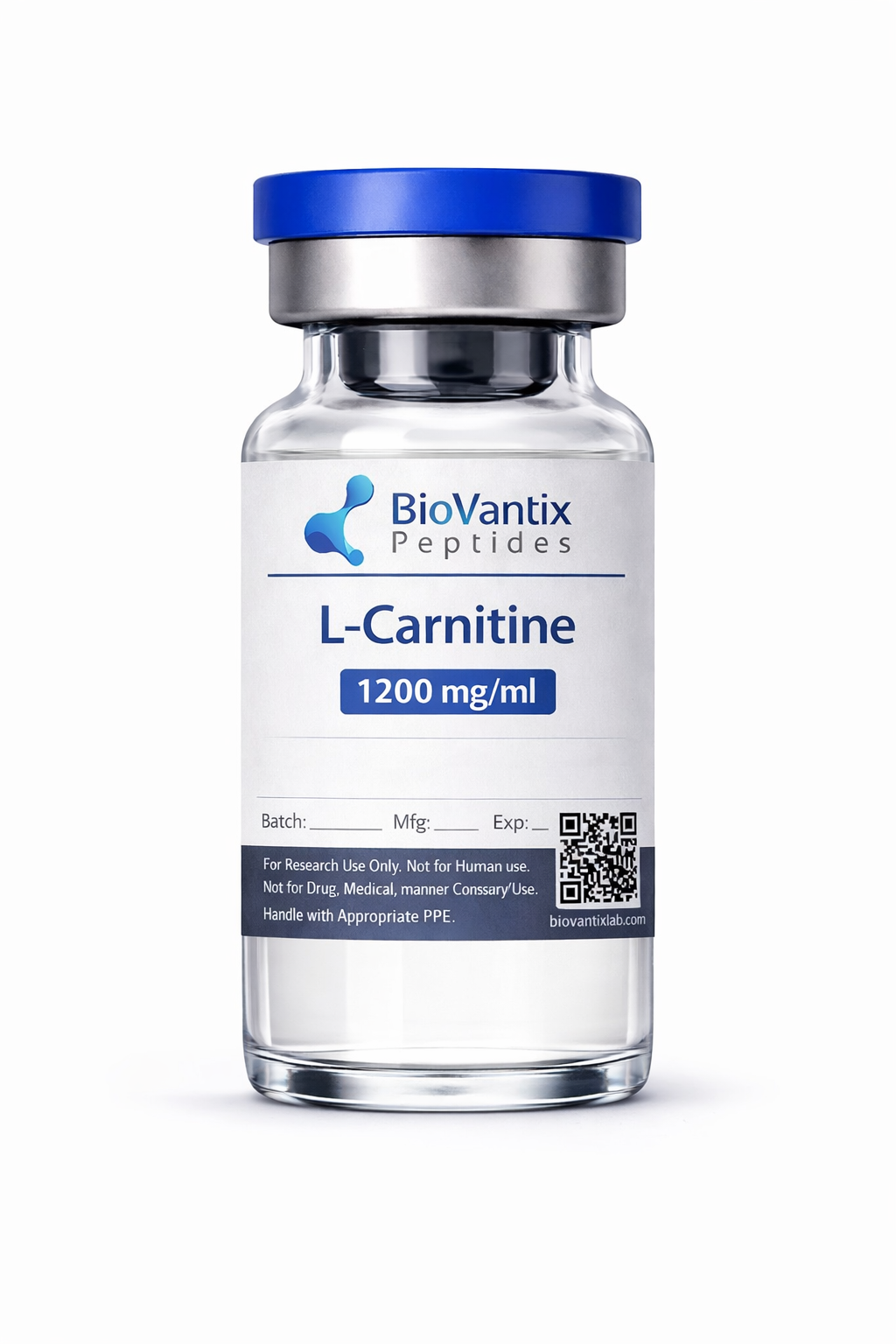
L-Carnitine 1200mg
L-Carnitine is a naturally occurring quaternary ammonium compound studied in metabolic research for its role in mitochondrial fatty acid transport and cellular energy metabolism. In experimental systems, L-carnitine facilitates the transport of long-chain fatty acids into the mitochondria, where they undergo β-oxidation and contribute to ATP production and energy regulation. Research investigates how L-carnitine influences mitochondrial function, metabolic signaling pathways, and lipid utilization under controlled laboratory conditions.
For research use only. Not for human consumption.
$85.00 Original price was: $85.00.$50.00Current price is: $50.00.
Availability: 38 in stock
All Peptides
Popular Peptides
Peptide Blends
What Is
L-Carnitine?
L-Carnitine is a naturally occurring compound derived from the amino acids lysine and methionine and is widely studied in metabolic and biochemical research for its involvement in mitochondrial energy metabolism. The molecule functions as a transport carrier responsible for shuttling long-chain fatty acids across the mitochondrial membrane, enabling their participation in β-oxidation and subsequent energy production.
In laboratory research settings, L-carnitine is investigated as a regulator of lipid metabolism, mitochondrial bioenergetics, and metabolic signaling pathways associated with nutrient utilization and cellular energy balance. Experimental investigations frequently examine how variations in L-carnitine availability influence mitochondrial function, fatty-acid oxidation, and metabolic homeostasis.
Across biochemical and physiological studies, L-carnitine has been associated with changes in metabolic endpoints frequently measured in research environments, including fatty-acid transport dynamics, mitochondrial respiration markers, and energy metabolism parameters. These findings are interpreted mechanistically through metabolic pathway interactions rather than as outcomes or claims of applied use.
L-Carnitine Structure
Chemical Class: Quaternary ammonium compound
Chemical Name: β-Hydroxy-γ-trimethylaminobutyric acid
Molecular Formula: C7H15NO3
Molecular Weight: 161.20 g/mol
CAS Number: 541-15-1
Synonyms: levocarnitine, L-carnitine base
L-Carnitine plays a central biochemical role in the carnitine shuttle, a mitochondrial transport system responsible for transferring long-chain fatty acids from the cytosol into the mitochondrial matrix. This transport process enables fatty acids to undergo β-oxidation, producing acetyl-CoA molecules that enter the citric acid cycle and contribute to ATP generation.
In biochemical research, L-carnitine is frequently examined as a mediator of mitochondrial energy metabolism, lipid oxidation pathways, and metabolic regulatory signaling.
L-Carnitine Research
L-Carnitine is commonly used in laboratory research examining mitochondrial function, fatty-acid metabolism, and metabolic energy pathways. Experimental investigations frequently involve cell-based metabolic assays evaluating mitochondrial respiration and lipid oxidation processes.
Typical experimental endpoints studied include:
- mitochondrial fatty-acid transport
- β-oxidation activity
- ATP production pathways
- cellular energy metabolism markers
- lipid utilization signaling pathways
Animal and clinical research models have also been used to explore how L-carnitine influences metabolic regulation, mitochondrial efficiency, and systemic energy metabolism.
Referenced Citations
[1] Flanagan JL, Simmons PA, Vehige J, Willcox MD, Garrett Q.
Role of carnitine in disease.
https://pubmed.ncbi.nlm.nih.gov/20854832/[2] Longo N, Frigeni M, Pasquali M.
Carnitine transport and fatty acid oxidation.
https://pubmed.ncbi.nlm.nih.gov/20378141/[3] Rebouche CJ, Seim H.
Carnitine metabolism and its regulation in mammals.
https://pubmed.ncbi.nlm.nih.gov/15591001/[4] Brass EP.
Carnitine and energy metabolism in humans.
https://pubmed.ncbi.nlm.nih.gov/9825173/[5] PubChem.
L-Carnitine compound summary.
https://pubchem.ncbi.nlm.nih.gov/compound/L-Carnitine
Storage Instructions:
All of our products are manufactured using the Lyophilization (Freeze Drying) process, which ensures that our products remain 100% stable for shipping for up to 3-4 months.
Once the peptides are reconstituted (mixed with bacteriostatic water), they must be stored in the fridge to maintain stability. After reconstitution, the peptides will remain stable for up to 30 days.
Lyophilization is a unique dehydration process, also known as cryodesiccation, where the peptides are frozen and then subjected to low pressure. This causes the water in the peptide vial to sublimate directly from solid to gas, leaving behind a stable, crystalline white structure known as lyophilized peptide. The puffy white powder can be stored at room temperature until you’re ready to reconstitute it with bacteriostatic water.
Once peptides have been received, it is imperative that they are kept cold and away from light. If the peptides will be used immediately, or in the next several days, weeks or months, short-term refrigeration under 4C (39F) is generally acceptable. Lyophilized peptides are usually stable at room temperatures for several weeks or more, so if they will be utilized within weeks or months such storage is typically adequate.
However, for longer term storage (several months to years) it is more preferable to store peptides in a freezer at -80C (-112F). When storing peptides for months or even years, freezing is optimal in order to preserve the peptide’s stability.
For further information on proper storage techniques, click the link below:
Peptide Storage