

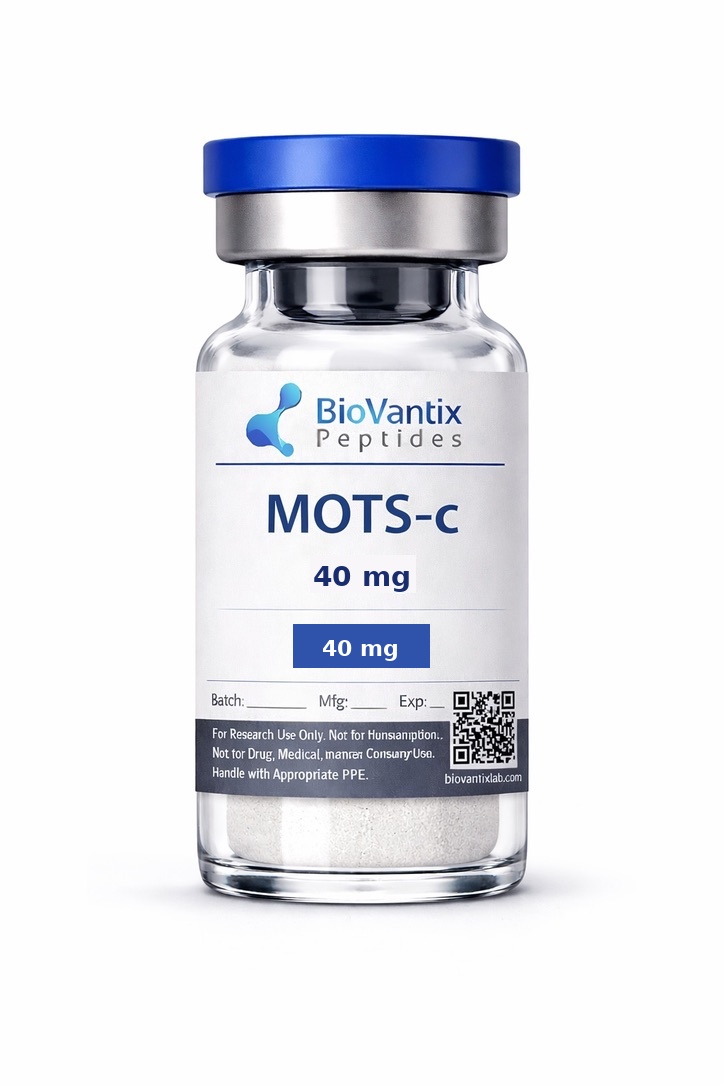
1. Overview
2. Biochemical Characteristics
3. Research Applications
4. Pathway / Mechanistic Context
5. Summary of Preclinical Research
6. Form & Analysis Testing
7. Referenced Citations
8. RUO Disclaimer
Overview
MOTS-c is a short peptide encoded by the mitochondrial genome and described in the scientific literature as a member of the mitochondrial-derived peptide (MDP) family. Publications on MDPs describe these peptides in the context of mitochondrial signaling and inter-organelle communication in experimental systems.
Reports on MOTS-c describe its identification in cellular compartments, including the mitochondria and the nucleus, under defined experimental conditions. Observations regarding the peptide’s localization and molecular interactions are limited to non-clinical research settings and are presented as descriptive findings in cell- and animal-based studies.
All references to MOTS-c are confined to mechanistic and observational research contexts and do not extend beyond laboratory research.
Biochemical Characteristics
RUO Disclaimer

MOTS-c Structure, by BQUB17-JHolguera – Own work, CC BY-SA 4.0
Source: Wikipedia
Sequence: Met-Arg-Trp-Gln-Glu-Met-Gly-Tyr-Ile-Phe-Tyr-Pro-Arg-Lys-Leu-Arg Molecular Formula: C101H152N28O22S2 Molecular Weight: 2174.64 g/mol PubChem SID: 255386757 CAS Number: 1627580-64-6 Reported Synonyms: Mitochondrial 12S rRNA-c Open Reading Frame, MT-RNR1
MOTS-c is a 16-amino acid peptide whose primary structure and molecular composition have been characterized in biochemical research sources. Structural descriptions are limited to physicochemical properties and reported sequence information derived from non-clinical research references.
Research Applications
In the scientific literature, MOTS-c has been referenced in non-clinical research involving cellular assays and animal studies. These publications describe experimental contexts in which molecular interactions, signaling components, and markers associated with metabolic pathways were observed and documented.
Reported research applications include the investigation of:
- Molecular components associated with mitochondrial signaling
- Nuclear translocation phenomena under experimental conditions
- AMPK-associated signaling elements
- Molecular markers related to metabolic pathways
- Gene expression patterns evaluated in cellular and animal models
All reported applications are limited to descriptive research conducted in controlled laboratory environments.
Pathway / Mechanistic Context
In preclinical publications, the mechanisms associated with MOTS-c are described in relation to intracellular signaling pathways involved in molecular energy-sensing and stress-response networks, including components of the AMPK signaling pathway.
Additional references describe experimental observations of MOTS-c localization within the nucleus under defined laboratory conditions, together with reported associations involving the transcriptional regulation of nuclear-encoded genes. These descriptions are limited to molecular and biochemical observations within experimental systems.
All pathway-related descriptions are restricted to non-clinical research contexts and do not imply functional outcomes.
Summary of Preclinical Research
Preclinical studies cited in the scientific literature describe observations involving MOTS-c in cellular and animal model systems. Reported findings include measurements of signaling-associated proteins, metabolite profiles, and gene expression markers recorded under defined experimental conditions.
Additional publications describe associations between MOTS-c and molecular characteristics observed in experimental models of metabolic stress and mitochondrial dysfunction. All reported findings are limited to the experimental systems employed.
Form & Analysis Testing
MOTS-c is supplied as research-grade peptide material. Its identity and composition have been characterized using analytical techniques commonly applied to research peptides, including chromatographic methods and mass spectrometry.
Handling, storage, and analytical verification parameters are determined by each laboratory according to its internal research protocols.
Article Author
The above literature was researched, edited, and organized by Dr. Logan, M.D. Dr. Logan holds an M.D. from Case Western Reserve University School of Medicine and a bachelor’s degree in Molecular Biology.
Scientific Journal Author
Dr. Changhan David Lee, co-author of “MOTS-c: A Novel Mitochondrial-Derived Peptide Regulating Muscle and Fat Metabolism” and “The Mitochondrial-Encoded Peptide MOTS-c Translocates to the Nucleus to Regulate Nuclear Gene Expression in Response to Metabolic Stress”, is a researcher at the USC Leonard Davis School of Gerontology.
Pinchas Cohen, M.D., is Dean of the USC Leonard Davis School of Gerontology, Executive Director of the Ethel Percy Andrus Gerontology Center, and holder of the William and Sylvia Kugel Dean’s Chair in Gerontology. He is recognized for his research on mitochondrial peptides and their potential therapeutic relevance to diabetes, Alzheimer’s disease, and other age-related conditions. Dr. Cohen’s current research focuses on the emerging field of mitochondrial-derived peptides, which he discovered. These peptides include Humanin, a 24-amino acid peptide encoded within the mitochondrial 16S rRNA, described as a novel metaboloprotective and centrally acting insulin-sensitizing factor representing a potential therapeutic and diagnostic target for diabetes and related diseases. Other mitochondrial peptides of interest include MOTS-c, a second peptide encoded by a small open reading frame within the mitochondrial 12S region, and SHLP2, a peptide encoded by the light strand of the mitochondrial 16S rRNA region.
Dr. Changhan David Lee and Dr. Pinchas Cohen are referenced as leading scientists involved in the research and development of MOTS-c. These physicians/scientists do not endorse or recommend the purchase, sale, or use of this product for any purpose. There is no affiliation or relationship, express or implied, between Peptide Sciences and these physicians. The purpose of referencing these scientists is solely to acknowledge and credit their extensive research and development efforts related to this peptide. Dr. Changhan David Lee is cited in references [1] and [3]. Dr. Pinchas Cohen is cited in reference [9].
Referenced Citations
- C. Lee, K. H. Kim, and P. Cohen, “MOTS-c: A novel mitochondrial-derived peptide regulating muscle and fat metabolism,” Free Radical Biology & Medicine, vol. 100, pp. 182–187, Nov. 2016.
- H. Lu et al., “MOTS-c peptide regulates adipose homeostasis to prevent ovariectomy-induced metabolic dysfunction,” Journal of Molecular Medicine, vol. 97, no. 4, pp. 473–485, Apr. 2019.
- K. H. Kim, J. M. Son, B. A. Benayoun, and C. Lee, “The Mitochondrial-Encoded Peptide MOTS-c Translocates to the Nucleus to Regulate Nuclear Gene Expression in Response to Metabolic Stress,” Cell Metabolism, vol. 28, no. 3, pp. 516–524.e7, Sep. 2018.
- S.-J. Kim et al., “The mitochondrial-derived peptide MOTS-c is a regulator of plasma metabolites and enhances insulin sensitivity,” Physiological Reports, vol. 7, no. 13, p. e14171, Jul. 2019.
- R. Crescenzo et al., “A possible link between hepatic mitochondrial dysfunction and diet-induced insulin resistance,” European Journal of Nutrition, vol. 55, no. 1, pp. 1–6, Feb. 2016.
- L. R. Cataldo et al., “Plasma MOTS-c levels are associated with insulin sensitivity in lean but not in obese individuals,” Journal of Investigative Medicine, vol. 66, no. 6, pp. 1019–1022, Aug. 2018.
- N. Che et al., “MOTS-c improves osteoporosis by promoting the synthesis of type I collagen in osteoblasts via TGF-β/SMAD signaling pathway,” European Review for Medical and Pharmacological Sciences, vol. 23, no. 8, pp. 3183–3189, Apr. 2019.
- B.-T. Hu and W.-Z. Chen, “MOTS-c improves osteoporosis by promoting osteogenic differentiation of bone marrow mesenchymal stem cells via the TGF-β/Smad pathway,” European Review for Medical and Pharmacological Sciences, vol. 22, no. 21, pp. 7156–7163, Nov. 2018.
- N. Fuku et al., “The mitochondrial-derived peptide MOTS-c: A player in exceptional longevity?,” Aging Cell, vol. 14, Aug. 2015.
- Q. Qin et al., “Downregulation of circulating MOTS-c levels in patients with coronary endothelial dysfunction,” International Journal of Cardiology, vol. 254, pp. 23–27, Jan. 2018.
- Y. Yang et al., “The role of mitochondria-derived peptides in cardiovascular disease: Recent updates,” Biomedicine & Pharmacotherapy, vol. 117, p. 109075, Jun. 2019.
ALL ARTICLES AND PRODUCT INFORMATION PROVIDED ON THIS WEBSITE ARE FOR INFORMATIONAL AND EDUCATIONAL PURPOSES ONLY.
RUO Disclaimer
The products offered on this website are supplied exclusively for in vitro studies. In vitro studies (Latin for “in glass”) are conducted outside the body. These products are not drugs or pharmaceuticals and have not been approved by the FDA to prevent, treat, or cure any disease or medical condition. Introduction of these products into the body, whether in humans or animals, is strictly prohibited by law.
For laboratory research use only. Not for human, medical, diagnostic, or veterinary use.