
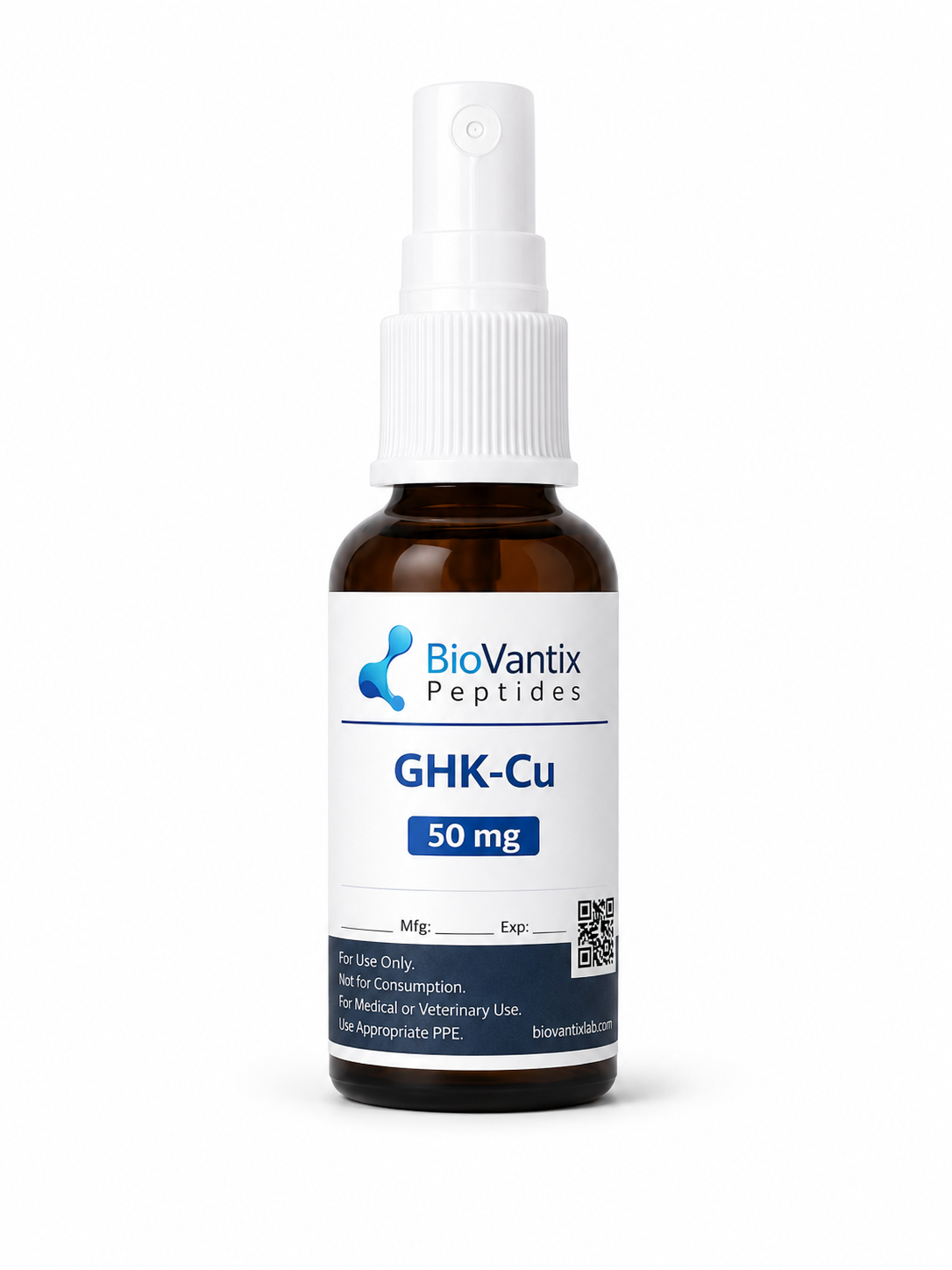
GHK-Cu 50mg 15ml Topical Spray
GHK-Cu Topical Spray (50 mg / 30 mL) is an aqueous copper peptide formulation designed for topical application in dermal and scalp research models. Each 30 mL amber glass spray bottle contains GHK-Cu (Gly-His-Lys·Cu²⁺) at a concentration of 1.67 mg/mL, delivered through a metered spray mechanism that enables precise and repeatable topical dosing in experimental protocols. The formulation is optimized for studies involving transdermal absorption, extracellular matrix remodeling, and follicular biology. The amber glass container provides photoprotection for the copper peptide complex, helping preserve its stability during typical laboratory storage and handling conditions.
References:
Pickart L et al., BioMed Research International, 2015
Maquart FX et al., FEBS Letters, 1988;238(2):343–346
Siméon A et al., Journal of Investigative Dermatology, 2000;115(6):961–968
This topical spray is supplied exclusively as a laboratory research material for handling and evaluation in experimental settings. It is not a pharmaceutical product and is not intended for human or veterinary use. It must not be used for diagnostic, therapeutic, or clinical purposes.
For research use only. Not for human or animal use.
$95.00 Original price was: $95.00.$79.00Current price is: $79.00.
Availability: 8 in stock
All Peptides
Popular Peptides
Peptide Blends
Overview
GHK-Cu (copper glycyl-L-histidyl-L-lysine) is a naturally occurring copper(II)-tripeptide coordination complex studied in preclinical research as a regulator of copper bioavailability and copper-dependent signaling. The tripeptide ligand (GHK) chelates Cu²⁺ with high affinity, enabling controlled investigation of copper sequestration, release, and redistribution in extracellular and cellular environments. Experimental literature has evaluated GHK-Cu in a variety of in vitro systems and in vivo animal models as a probe for pathways associated with metal ion homeostasis, redox regulation, extracellular matrix turnover, and injury-response transcriptional programs. Across multiple laboratory models, GHK-Cu has been observed to influence processes commonly monitored as preclinical parameters, including collagen/elastin-associated extracellular matrix synthesis, angiogenesis-related signaling, antioxidant response pathways, immune cell recruitment, and proteostasis. These observations are interpreted from a mechanistic perspective as copper-mediated modulation of enzymatic activity, transcription factor signaling, and gene expression networks, rather than as outcomes or claims regarding applied use.
Biochemical Characteristics
Amino Acid Sequence: Gly-His-Lys(Cu²⁺) Molecular Formula: C₁₆H₂₈CuN₆O₆-2 Molecular Weight: 463.98 g/mol PubChem ID: 156588903 CAS Number: 49557-75-7 Synonyms: Copper Glycyl-Histidyl-Lysine, Laminin
Source: PubChem
GHK coordinates Cu²⁺ through nitrogen- and oxygen-donor atoms provided by the N-terminal glycine, the histidine imidazole ring, and functional groups associated with lysine, forming a stable yet exchange-capable complex in aqueous systems. This coordination chemistry is used in laboratory research to study copper distribution among peptide ligands, proteins, and cellular compartments, as well as copper-dependent catalytic and redox processes under defined experimental conditions.
Research Applications
GHK-Cu is used as a research reagent in mechanistic studies of copper homeostasis and copper-sensitive signaling. Typical preclinical applications include cellular assays examining the response to oxidative stress (e.g., reactive oxygen species handling and antioxidant pathway activation), transcriptional profiling of inflammatory and metal-responsive gene networks, and extracellular matrix (ECM) remodeling indicators (e.g., collagen-associated transcription/protein markers, elastin-associated markers, and regulation of matrix metalloproteinases) in fibroblast, epithelial, and endothelial model systems.
In vivo animal studies and ex vivo tissue models employ GHK-Cu to investigate injury-response programs, including angiogenesis-associated signaling, immune cell recruitment phenotypes, and remodeling-associated gene expression patterns. In preclinical neurobiology-focused research, GHK-Cu is also evaluated as a reference compound for investigating the relationship between copper availability and protein aggregation/clearance pathways under controlled experimental conditions.
Pathway / Mechanistic Context
From a mechanistic perspective, GHK-Cu is studied as a copper delivery and buffering complex capable of influencing copper-dependent enzymes and signaling pathways. The preclinical literature describes modulation of oxidative stress pathways through changes in the availability of redox-active copper and the subsequent regulation of antioxidant defenses. GHK-Cu has also been associated with altered activity of inflammatory signaling nodes, including transcriptional programs linked to NF-κB, in cellular and animal models.
Gene expression studies have reported broad transcriptional changes following in vitro exposure to GHK-Cu, including changes in genes associated with DNA repair, proteostasis, and extracellular matrix organization. These observations are used to investigate how copper-ligand complexes may remodel cellular stress responses and remodeling programs at the transcriptional level, including potential epigenetic factors contributing to metal-responsive gene regulation.
In protein aggregation research, copper is a key variable in the redox chemistry and aggregation kinetics of several amyloidogenic proteins. Laboratory studies evaluate whether copper sequestration by GHK can modify copper-catalyzed oxidative reactions and aggregation behavior under defined conditions. This work is framed strictly as mechanistic research into the contributions of metal ions to protein misfolding and aggregate formation.
Source: Semantic Scholar
Summary of Preclinical Research
Preclinical studies of GHK-Cu include in vitro experiments in relevant fibroblast, endothelial, epithelial, and immune cell models, as well as in vivo animal studies in which injury-response endpoints are quantified. Commonly reported findings include changes in ECM-associated transcription/protein markers (e.g., collagen/elastin-related signals), modulation of inflammatory cytokine signaling (including pathways involving TNF-α and IL-6), and altered oxidative stress parameters consistent with the involvement of antioxidant response pathways.
Additional literature on animal models describes changes in remodeling markers and angiogenesis-associated signaling in tissue injury paradigms. Furthermore, transcriptomic analyses described in the cited literature report that exposure to GHK-Cu may alter the expression of a substantial subset of genes measured in vitro, supporting its use as a laboratory tool for investigating copper-linked transcriptional regulation and downstream pathway enrichment patterns. Research into the involvement of metal ions in amyloidogenic protein chemistry has also examined GHK-Cu as a copper-sequestering variable in controlled toxicity and aggregation assay designs.
All of the above summaries refer exclusively to controlled preclinical research and are provided to support experimental design considerations, mechanistic hypothesis generation, and pathway mapping in laboratory settings.
Form & Analysis Testing
GHK-Cu is supplied as a research-grade peptide-metal complex. Its identity and composition are routinely evaluated using analytical methods such as HPLC for purity profiling and mass spectrometry for molecular confirmation. Copper content/stoichiometry is evaluated, where applicable, using techniques such as ICP-MS/ICP-OES or other validated elemental analysis methods. UV-Vis spectroscopy or similar spectroscopic methods may be used to characterize copper coordination properties in solution under defined laboratory conditions.
Researchers should handle peptide-metal complexes according to standard laboratory practices appropriate for synthetic peptides and transition metal coordination compounds, including controls for metal contamination, chelator compatibility, and the effects of buffer composition on copper speciation during experimental preparation.
Article Author
The above literature was researched, edited, and organized by Dr. E. Logan, M.D. Dr. E. Logan earned his M.D. from the Case Western Reserve University School of Medicine and holds a bachelor’s degree in Molecular Biology.
Scientific Journal Author
Loren Pickart, Ph.D., has published 109 scientific papers and continues to develop patents while investigating the effects of GHK on the expression of 4,192 human genes. In addition to the published potential applications of GHK in skin inflammation, metastatic cancer, and COPD, it appears to exert beneficial effects in other tissue systems, including the nervous system, gastrointestinal system, and mitochondrial system. His concise yet detailed autobiography explores the motivations and background behind his lifelong dedication to skin biology, anti-aging research, and scientific investigation.
Loren Pickart, Ph.D., is referenced as one of the leading scientists involved in the research and development of GHK-Cu. This physician/scientist does not endorse or promote the purchase, sale, or use of this product for any purpose. There is no affiliation or relationship, express or implied, between Peptide Sciences and this physician. The purpose of citing this physician is solely to recognize and credit the extensive research and development efforts of the scientists who have studied this peptide. Loren Pickart, Ph.D., is cited in references [3], [4], and [8].
Referenced Citations
- S. O. Canapp et al., “The effect of topical tripeptide-copper complex on healing of ischemic open wounds,” Veterinary Surgery, vol. 32, no. 6, Dec. 2003, doi:10.1111/j.1532-950X.2003.00515.x.
- Y. Dou, A. Lee, L. Zhu, J. Morton, and W. Ladiges, “The potential of GHK as an anti-aging peptide,” Aging Pathobiology and Therapeutics, vol. 2, no. 1, pp. 58–61, Mar. 2020, doi:10.31491/APT.2020.03.014.
- L. Pickart, “The human tri-peptide GHK and tissue remodeling,” Journal of Biomaterials Science, Polymer Edition, vol. 19, no. 8, pp. 969–988, 2008, doi:10.1163/156856208784909435.
- L. Pickart and A. Margolina, “Regenerative and Protective Actions of the GHK-Cu Peptide in the Light of the New Gene Data,” International Journal of Molecular Sciences, vol. 19, no. 7, p. 1987, Jul. 2018, doi:10.3390/ijms19071987.
- S. Montes, S. Rivera-Mancia, A. Diaz-Ruiz, L. Tristan-Lopez, and C. Rios, “Copper and Copper Proteins in Parkinson’s Disease,” Oxidative Medicine and Cellular Longevity, vol. 2014, p. e147251, Jan. 2014, doi:10.1155/2014/147251.
- H. Kozlowski, M. Luczkowski, M. Remelli, and D. Valensin, “Copper, zinc and iron in neurodegenerative diseases (Alzheimer’s, Parkinson’s and prion diseases),” Coordination Chemistry Reviews, vol. 256, no. 19, pp. 2129–2141, Oct. 2012, doi:10.1016/j.ccr.2012.03.013.
- K. Rajasekhar, C. Madhu, and T. Govindaraju, “Natural Tripeptide-Based Inhibitor of Multifaceted Amyloid β Toxicity,” ACS Chemical Neuroscience, vol. 7, no. 9, pp. 1300–1310, Sep. 2016, doi:10.1021/acschemneuro.6b00175.
- L. Pickart, J. M. Vasquez-Soltero, and A. Margolina, “GHK and DNA: Resetting the Human Genome to Health,” BioMed Research International, vol. 2014, p. 151479, 2014, doi:10.1155/2014/151479.
- Y. Wu, K. Cao, W. Zhang, G. Zhang, and M. Zhou, “Protective and Anti-Aging Effects of 5 Cosmeceutical Peptide Mixtures on Hydrogen Peroxide-Induced Premature Senescence in Human Skin Fibroblasts,” Skin Pharmacology and Physiology, vol. 34, no. 4, pp. 194–202, 2021, doi:10.1159/000514496.
- X. Yang, Y. Zhang, C. Huang, L. Lu, J. Chen, and Y. Weng, “Biomimetic Hydrogel Scaffolds with Copper Peptide-Functionalized RADA16 Nanofiber Improve Wound Healing in Diabetes,” Macromolecular Bioscience, vol. 22, no. 8, p. e2200019, Aug. 2022, doi:10.1002/mabi.202200019.
- X. Wang et al., “GHK-Cu-liposomes accelerate scald wound healing in mice by promoting cell proliferation and angiogenesis,” Wound Repair and Regeneration, vol. 25, no. 2, pp. 270–278, Apr. 2017, doi:10.1111/wrr.12520.
- Q. Zhang, L. Yan, J. Lu, and X. Zhou, “Glycyl-L-histidyl-L-lysine-Cu²⁺ attenuates cigarette smoke-induced pulmonary emphysema and inflammation by reducing oxidative stress pathway,” Frontiers in Molecular Biosciences, vol. 9, p. 925700, 2022, doi:10.3389/fmolb.2022.925700.
- J.-R. Park, H. Lee, S.-I. Kim, and S.-R. Yang, “The tri-peptide GHK-Cu complex ameliorates lipopolysaccharide-induced acute lung injury in mice,” Oncotarget, vol. 7, no. 36, pp. 58405–58417, Sep. 2016, doi:10.18632/oncotarget.11168.
- M. Kukowska, M. Kukowska-Kaszuba, and K. Dzierzbicka, “In vitro studies of antimicrobial activity of Gly-His-Lys conjugates as potential and promising candidates for therapeutics in skin and tissue infections,” Bioorganic & Medicinal Chemistry Letters, vol. 25, no. 3, pp. 542–546, Feb. 2015, doi:10.1016/j.bmcl.2014.12.029.
- W. Shen and T. Matsui, “Intestinal absorption of small peptides: a review,” International Journal of Food Science & Technology, vol. 54, no. 6, pp. 1942–1948, 2019, doi:10.1111/ijfs.14048.
ALL ARTICLES AND PRODUCT INFORMATION PROVIDED ON THIS WEBSITE ARE FOR INFORMATIONAL AND EDUCATIONAL PURPOSES ONLY.
RUO Disclaimer
The products offered on this website are provided exclusively for in vitro studies. In vitro studies (Latin for “in glass”) are conducted outside the body. These products are not drugs or pharmaceuticals and have not been approved by the FDA to prevent, treat, or cure any condition, illness, or disease. Their introduction into the body, whether human or animal, is strictly prohibited by law.
For Research Use Only (RUO). Not for human consumption.