

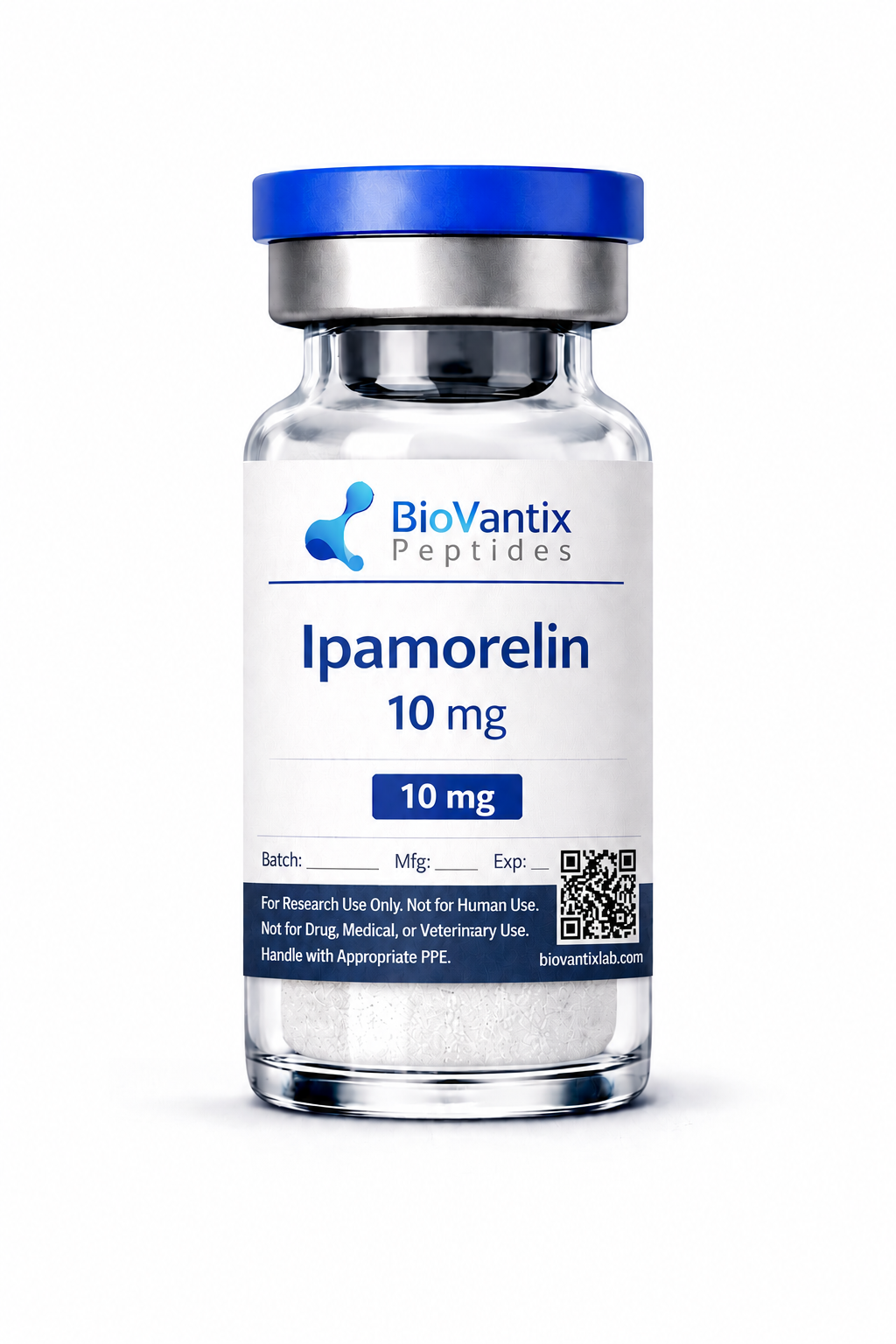
Ipamorelin 10mg
Ipamorelin is a synthetic pentapeptide studied in experimental research for its interaction with growth hormone secretagogue receptor (GHSR) signaling pathways. In laboratory models, ipamorelin is investigated for its role in growth hormone release mechanisms, endocrine signaling, and metabolic regulation, providing researchers with a valuable tool for studying peptide-mediated modulation of the somatotropic axis.
For research use only. Not for human consumption.
$115.00 Original price was: $115.00.$80.00Current price is: $80.00.
Availability: 14 in stock
All Peptides
Popular Peptides
Peptide Blends
What Is Ipamorelin?
Ipamorelin is a synthetic pentapeptide belonging to the growth hormone secretagogue (GHS) class. It is investigated in experimental research as a selective agonist of the growth hormone secretagogue receptor (GHSR), a receptor associated with the regulation of growth hormone signaling and endocrine function.
Laboratory research investigates Ipamorelin as a research compound for examining growth hormone release mechanisms, metabolic signaling pathways, and endocrine regulatory systems. The peptide’s receptor selectivity allows researchers to explore growth hormone signaling without significantly activating other hormonal pathways commonly associated with earlier growth hormone secretagogues.
In experimental models, Ipamorelin has been associated with measurable changes in endpoints commonly monitored in endocrine research, including growth hormone secretion dynamics, insulin-like growth factor signaling, and metabolic regulatory pathways. These observations are interpreted mechanistically through receptor-mediated signaling processes rather than as outcomes or claims of applied use.
Ipamorelin Structure
Peptide Class: Growth hormone secretagogue peptide
Amino Acid Sequence: Aib-His-D-2-Nal-D-Phe-Lys-NH₂
Molecular Formula: C38H49N9O5
Molecular Weight: ~711.85 g/mol
CAS Number: 170851-70-4
Synonyms: Ipamorelin acetate, GHS peptide analog
Ipamorelin is a synthetic pentapeptide analog designed to mimic the activity of endogenous growth hormone-releasing signaling molecules. Structural modifications incorporated into the peptide improve receptor affinity and stability, allowing researchers to investigate controlled activation of the growth hormone secretagogue receptor.
In experimental systems, these structural characteristics enable investigation of growth hormone signaling pathways and endocrine feedback mechanisms involved in metabolic regulation and physiological growth processes.
Ipamorelin Research
Ipamorelin is used in research examining growth hormone signaling pathways and endocrine regulatory systems. Experimental investigations frequently involve receptor activation assays designed to evaluate intracellular signaling following interaction with the GHSR.
Laboratory studies commonly investigate endpoints that include:
- growth hormone secretion signaling
- insulin-like growth factor (IGF-1) pathway activity
- endocrine signaling regulation
- metabolic pathway modulation
- hormonal feedback mechanisms
In vivo research models have also been used to investigate how Ipamorelin influences somatotropic axis signaling and metabolic regulatory networks.
Referenced Citations
-
[1] Smith RG, Van der Ploeg LH, Howard AD, et al.
Peptidomimetic Regulation of Growth Hormone Secretion.
https://pubmed.ncbi.nlm.nih.gov/7504789/“`
[2] Bowers CY.
Growth Hormone-Releasing Peptides and Growth Hormone Secretagogues.
https://pubmed.ncbi.nlm.nih.gov/10720450/[3] Raun K, Hansen BS, Johansen NL, et al.
Ipamorelin, a Novel Growth Hormone Secretagogue.
https://pubmed.ncbi.nlm.nih.gov/10359863/[4] Ghigo E, Arvat E, Muccioli G, Camanni F.
Growth Hormone-Releasing Peptides.
https://pubmed.ncbi.nlm.nih.gov/9497814/[5] PubChem.
Ipamorelin Compound Summary.
https://pubchem.ncbi.nlm.nih.gov/compound/Ipamorelin
“`
Storage Instructions:
All of our products are manufactured using the lyophilization (freeze-drying) process, ensuring that they remain 100% stable during shipping for up to 3–4 months.
Once peptides have been reconstituted (mixed with bacteriostatic water), they should be stored in a refrigerator to maintain stability. After reconstitution, peptides generally remain stable for up to 30 days.
Lyophilization is a specialized dehydration process, also known as freeze-drying, in which peptides are first frozen and then subjected to low pressure. This causes the water inside the peptide vial to sublime directly from a solid to a gas, leaving behind a stable, white crystalline structure known as a lyophilized peptide. This fluffy white powder can be stored at room temperature until it is ready to be reconstituted with bacteriostatic water.
Once your peptides have been received, it is essential to keep them cool and protected from light. If they will be used immediately, or within the next few days, weeks, or months, short-term refrigeration below 4°C (39°F) is generally acceptable. Lyophilized peptides are typically stable at room temperature for several weeks or longer, so if they will be used within weeks or months, room-temperature storage is generally appropriate.
However, for long-term storage (several months to years), peptides should ideally be kept in a freezer at -80°C (-112°F). When storing peptides for months or even years, freezing is the preferred method for preserving peptide stability.
For more information on proper storage techniques, click the following link:
http://biovantixlab.com/peptide-storage/