

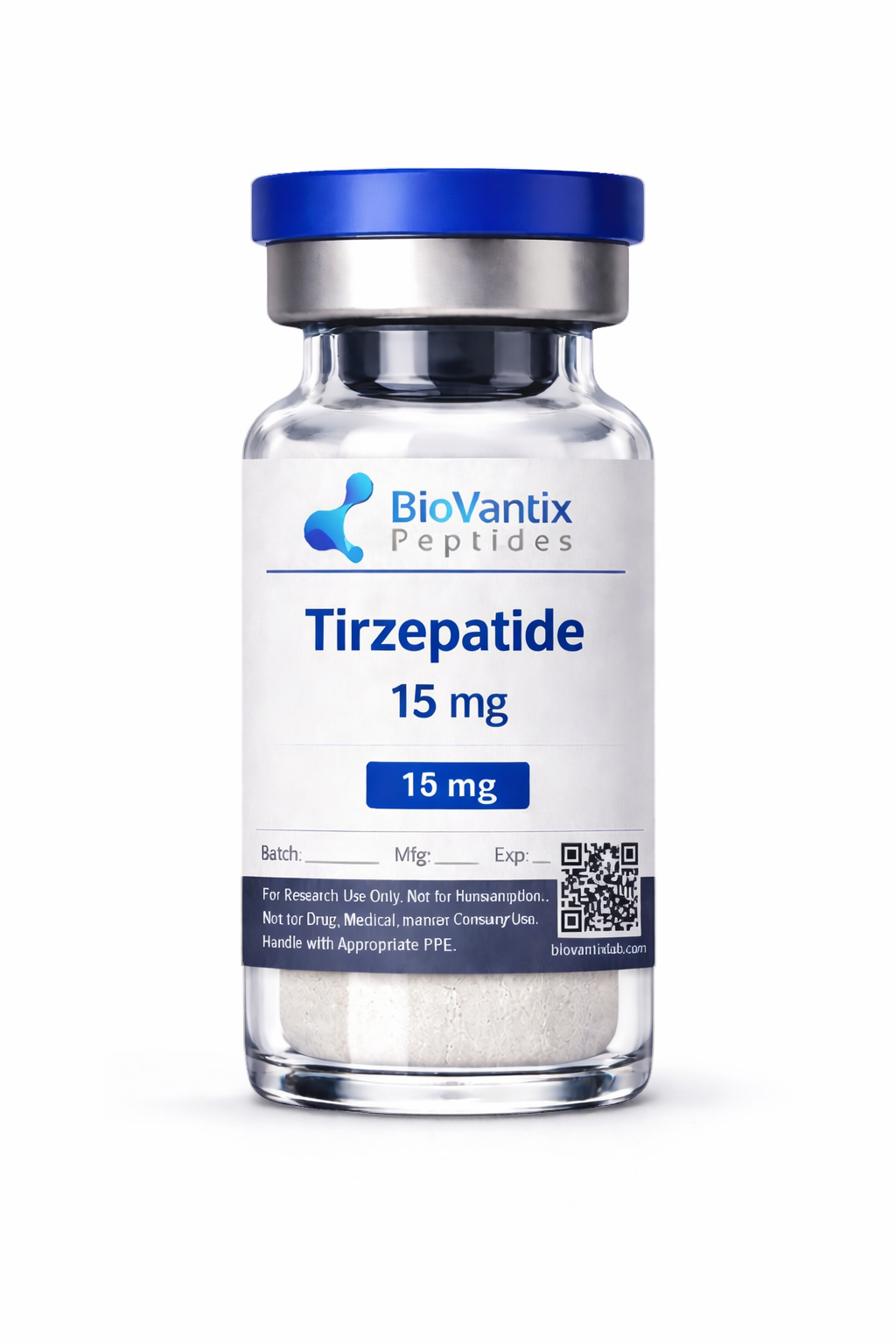
Tirzepatide 20mg
Tirzepatide is a synthetic dual incretin receptor agonist peptide studied in experimental and clinical research for its interaction with the glucose-dependent insulinotropic polypeptide (GIP) and glucagon-like peptide-1 (GLP-1) receptors. In laboratory settings, tirzepatide is investigated for its influence on glucose metabolism, insulin signaling, appetite-related hormonal pathways, and energy balance regulation through the coordinated activation of incretin-mediated metabolic signaling systems.
For research use only. Not for human consumption.
$155.00 Original price was: $155.00.$120.00Current price is: $120.00.
Availability: Out of stock
Popular Peptides
Peptide Blends
What Is Tirzepatide?
Tirzepatide is a synthetic peptide investigated in experimental and clinical research as a dual incretin receptor agonist, targeting both the glucose-dependent insulinotropic polypeptide (GIP) receptor and the glucagon-like peptide-1 (GLP-1) receptor. This dual agonist design allows researchers to study the coordinated activation of two key incretin pathways involved in metabolic regulation, endocrine signaling, and nutrient utilization.
In laboratory and clinical research, Tirzepatide has been evaluated as a research tool for investigating mechanisms related to glucose homeostasis, insulin signaling, appetite regulation, and systemic energy balance. By activating both GIP and GLP-1 receptors, the peptide provides an experimental model for exploring how multiple incretin pathways interact to influence metabolic signaling networks.
In experimental models and controlled clinical studies, Tirzepatide has been associated with measurable changes in metabolic parameters commonly monitored in research settings, including markers of glycemic regulation, indicators of insulin sensitivity, lipid metabolism pathways, and appetite-related hormonal signaling. These observations are interpreted mechanistically through receptor-mediated signaling effects rather than as outcomes or claims of applied use.
Tirzepatide Structure
Peptide Class: Dual incretin receptor agonist peptide
Target Receptors: GIP receptor, GLP-1 receptor
Molecular Formula: C225H348N48O68
Molecular Weight: ~4813 g/mol
CAS Number: 2023788-19-2
Synonyms: Tirzepatide, LY3298176
Tirzepatide is designed as a long-acting peptide analog intended to activate incretin hormone receptors involved in metabolic signaling. Structural modifications incorporated into the peptide increase resistance to enzymatic degradation and prolong biological activity in experimental systems.
These molecular characteristics allow researchers to investigate sustained receptor activation and prolonged metabolic signaling responses associated with the modulation of incretin pathways.
Source: PubChem
Tirzepatide Research
Tirzepatide is used in research examining incretin signaling mechanisms and metabolic regulatory pathways. Typical experimental applications include receptor activation assays that evaluate intracellular signaling cascades initiated by interaction with GLP-1 and GIP receptors.
Laboratory studies frequently evaluate parameters such as:
- glucose tolerance responses
- insulin secretion signaling
- pancreatic β-cell activity
- lipid metabolism markers
- appetite-related hormonal signaling
In vivo research models are also used to investigate how dual incretin receptor activation influences systemic metabolic regulation, nutrient utilization, and energy balance signaling networks.
These studies enable researchers to explore the physiological interaction between GIP and GLP-1 receptor pathways in metabolic homeostasis.
Referenced Citations
-
[1] Coskun T, Sloop KW, Loghin C, et al. LY3298176, a Novel Dual GIP and GLP-1 Receptor Agonist for the Treatment of Type 2 Diabetes and Obesity.
https://pubmed.ncbi.nlm.nih.gov/30549913/“`
[2] Frias JP, Nauck MA, Van J, et al. Efficacy and Safety of the Dual GIP and GLP-1 Receptor Agonist Tirzepatide in Type 2 Diabetes.
https://pubmed.ncbi.nlm.nih.gov/31875404/[3] Jastreboff AM, Aronne LJ, Ahmad NN, et al. Tirzepatide Once Weekly for the Treatment of Obesity.
https://pubmed.ncbi.nlm.nih.gov/35658024/[4] Knudsen LB, Lau J. The Discovery and Development of Incretin-Based Therapies.
https://pubmed.ncbi.nlm.nih.gov/28828695/[5] PubChem. Tirzepatide Compound Summary.
https://pubchem.ncbi.nlm.nih.gov/compound/Tirzepatide[6] Eli Lilly and Company. Tirzepatide (LY3298176) Mechanism of Action and Research Overview.
https://www.ncbi.nlm.nih.gov/pmc/articles/PMC8311106/
“`
Storage Instructions:
All of our products are manufactured using the lyophilization (freeze-drying) process, ensuring that they remain 100% stable during shipping for up to 3–4 months.
Once peptides have been reconstituted (mixed with bacteriostatic water), they should be stored in a refrigerator to maintain stability. After reconstitution, peptides generally remain stable for up to 30 days.
Lyophilization is a specialized dehydration process, also known as freeze-drying, in which peptides are first frozen and then subjected to low pressure. This causes the water inside the peptide vial to sublime directly from a solid to a gas, leaving behind a stable, white crystalline structure known as a lyophilized peptide. This fluffy white powder can be stored at room temperature until it is ready to be reconstituted with bacteriostatic water.
Once your peptides have been received, it is essential to keep them cool and protected from light. If the peptides will be used immediately, or within the next few days, weeks, or months, short-term refrigeration below 4°C (39°F) is generally acceptable. Lyophilized peptides are typically stable at room temperature for several weeks or longer, so if they will be used within weeks or months, room-temperature storage is generally appropriate.
However, for long-term storage (several months to years), peptides should ideally be kept in a freezer at -80°C (-112°F). When storing peptides for months or even years, freezing is the preferred method for preserving peptide stability.
For more information on proper peptide storage techniques, click the following link:
http://biovantixlab.com/peptide-storage/
:::