

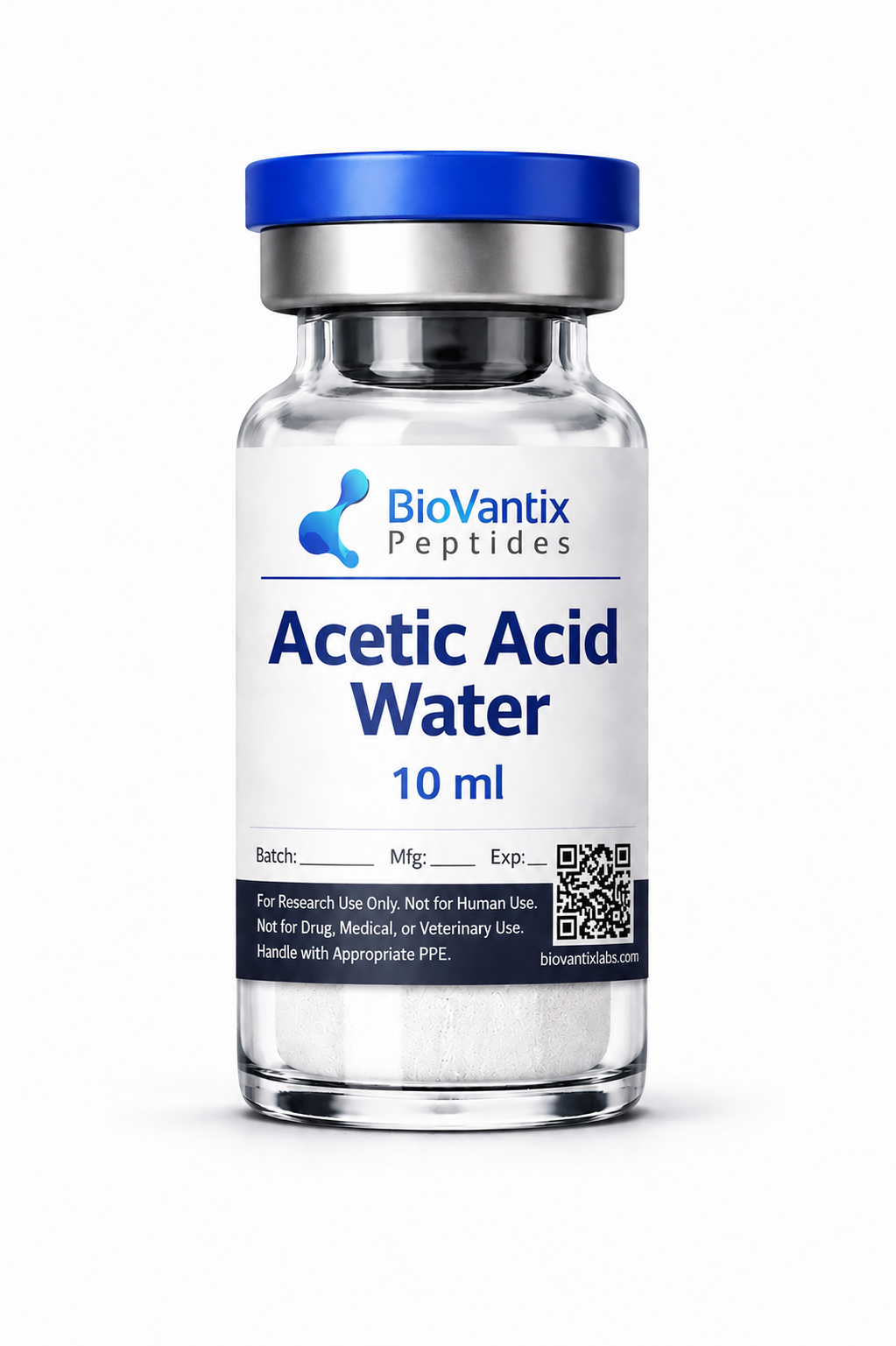
Acetic Acid Water
AA Water (Acetic Acid Water) is a sterile laboratory solution containing diluted acetic acid. It is commonly used in peptide research as a reconstitution medium for peptides that require a mildly acidic environment for optimal solubility. In experimental settings, AA Water is used to facilitate peptide dissolution, support solution preparation protocols, and maintain an appropriate pH for laboratory research involving peptide compounds.
For research use only. Not for human consumption.
$28.00 Original price was: $28.00.$18.00Current price is: $18.00.
Availability: 85 in stock
Popular Peptides
Peptide Blends
AA Water: General Overview
AA Water is commonly used in research environments as a slightly acidic aqueous solution, prepared with purified water and a low concentration of acetic acid. Within research environments involving peptides, AA Water is frequently employed as a reconstitution medium when researchers encounter compounds that demonstrate poor solubility, visible aggregation, or instability when mixed with simple bacteriostatic water or sterile water alone.
The primary purpose of AA Water is not to provide biological activity. Instead, it functions as a formulation and handling aid designed to create a more favorable solution environment for certain peptides and protein-based research materials. By slightly reducing the pH of the solution, AA Water can help improve dissolution characteristics and reduce the tendency of some molecules to form aggregates, precipitates, or gel-like structures during preparation.
Researchers typically evaluate multiple reconstitution vehicles—including sterile water, bacteriostatic water, saline solutions, buffered systems, and AA Water—to determine which medium provides the most consistent solubility and stability profile for a specific compound under laboratory conditions.
AA Water: Chemical Characteristics
AA Water consists primarily of highly purified water combined with a carefully controlled amount of acetic acid. Acetic acid is a simple organic acid that occurs naturally in many biological and environmental systems, and is widely used in analytical chemistry, biotechnology, pharmaceutical development, and laboratory research.
Key characteristics generally include:
- Water-based solution
- Slightly acidic pH environment
- Low ionic strength
- Minimal formulation complexity
- Compatibility with many analytical procedures
- Common use in peptide and protein preparation workflows
The acidic environment created by acetic acid can influence the charge distribution of the peptide and intermolecular interactions. Since peptide molecules often contain ionizable amino acid residues, small changes in pH can significantly alter solubility characteristics and solution behavior.
Therefore, AA Water is often considered a formulation tool rather than a biologically active substance.
AA Water: Research Applications
The research applications of AA Water commonly include:
Peptide Reconstitution
One of the most common uses involves dissolving lyophilized peptides that may not dissolve easily in neutral pH water. Certain hydrophobic peptides demonstrate improved dispersion when first exposed to a slightly acidic environment.
Solubility Optimization Studies
Researchers frequently compare different solvent systems to determine which conditions provide:
- Faster dissolution
- Reduced precipitation
- Lower aggregation rates
- Greater visual clarity
- Greater consistency between batches
Protein and Peptide Stability Research
Changes in pH can influence molecular stability, degradation pathways, and aggregation kinetics. Therefore, AA Water may be incorporated into studies evaluating short- and long-term storage behavior.
Analytical Sample Preparation
AA Water can be used during sample preparation for analytical techniques such as:
- High-Performance Liquid Chromatography (HPLC)
- Liquid Chromatography-Mass Spectrometry (LC-MS)
- Capillary electrophoresis
- Spectroscopic analysis
- Method development experiments
Formulation Development
Researchers studying new peptide formulations often evaluate multiple solvent environments during early development stages. AA Water can serve as a screening vehicle when evaluating dissolution characteristics and compatibility.
AA Water: Mechanistic Context
The scientific rationale behind AA Water centers on the relationship between pH and molecular behavior.
Many peptides contain amino acid residues capable of gaining or losing electrical charge depending on the surrounding environment. When the pH of the solution changes, the overall charge profile of the peptide may also change. These charge alterations can influence:
- Solubility
- Aggregation tendency
- Molecular interactions
- Conformational behavior
- Surface adsorption
- Stability characteristics
In some cases, slightly acidic conditions increase electrostatic repulsion between peptide molecules. Greater repulsion can reduce intermolecular attraction, decreasing the likelihood of aggregation or precipitation.
Researchers often describe this effect as an improvement in solution behavior, rather than as a change in the peptide’s biological properties themselves.
The extent of any benefit depends largely on the specific molecular structure being studied. A solvent system that improves the solubility of one peptide may have little effect—or even an unfavorable effect—on another compound.
AA Water: Formulation Considerations
When evaluating AA Water as a research solvent, researchers commonly assess several parameters:
pH
The level of acidity in the solution can directly influence peptide behavior. Even relatively small pH changes can alter solubility profiles and stability characteristics.
Peptide Sequence
Hydrophobicity, molecular weight, amino acid composition, and overall charge distribution contribute to how a peptide responds to acidic conditions.
Concentration
Highly concentrated peptide solutions may exhibit different dissolution characteristics compared to diluted preparations.
Storage Conditions
Temperature, light exposure, container materials, and storage duration can influence the overall stability of the solution.
Compatibility
Researchers may assess compatibility with:
- Laboratory plastics
- Glass containers
- Filtration systems
- Analytical instrumentation
- Buffer systems
- Subsequent experimental procedures
AA Water: Analytical Testing
Analytical characterization of AA Water generally focuses on confirming the quality and consistency of the solution.
Common testing parameters may include:
Identity Verification
Verification that the solution contains the intended components and appropriate concentration ranges.
pH Measurement
Precise determination of solution acidity using calibrated instrumentation.
Purity Evaluation
Assessment of unwanted contaminants that could interfere with research results.
Sterility Testing
When appropriate, testing can be performed to verify the absence of microbial contamination.
Endotoxin Analysis
Evaluation of bacterial endotoxin levels in research-grade preparations.
Appearance Evaluation
Inspection for:
- Color changes
- Particulate matter
- Turbidity
- Precipitation
- Container defects
Stability Monitoring
Researchers may conduct accelerated and real-time stability studies to evaluate how solution characteristics change over time.
AA Water: Research Advantages
Potential reasons why researchers may choose AA Water include:
- Simple formulation
- Slightly acidic environment
- Potential support for peptide dissolution
- Widespread laboratory familiarity
- Compatibility with many analytical workflows
- Utility during formulation development experiments
However, suitability varies by compound and should be evaluated experimentally rather than assumed.
AA Water: Research Limitations
AA Water is not universally optimal for all peptides or biological materials.
Potential limitations include:
- Variable effects between different molecules
- Possible incompatibility with pH-sensitive compounds
- Need for validation under specific experimental conditions
- Potential influence on subsequent analytical methods
- Requirement for proper storage and handling practices
Because peptide chemistry is highly specific to each compound, empirical testing remains the most reliable method for determining whether AA Water provides significant advantages in a particular research setting.
AA Water: Literature and Scientific Context
AA Water itself is not typically the subject of clinical efficacy research, as it is a solvent system rather than a therapeutic agent. Instead, scientific literature focuses on broader topics including:
- Peptide solubility
- Protein aggregation
- Formulation chemistry
- pH-dependent stability
- Analytical method development
- Biopharmaceutical preparation techniques
Within these fields, acidic aqueous systems are widely recognized as useful tools for investigating molecular behavior and optimizing formulation conditions.
Compliance Note
AA Water is a laboratory reagent and formulation vehicle, not a drug, medication, or therapeutic treatment. Any discussion of AA Water must be limited to its role in research, formulation, analytical testing, and laboratory preparation procedures. Research materials should not be presented as approved medical products, treatments, or therapies unless they have the appropriate regulatory authorization and specific product approval.